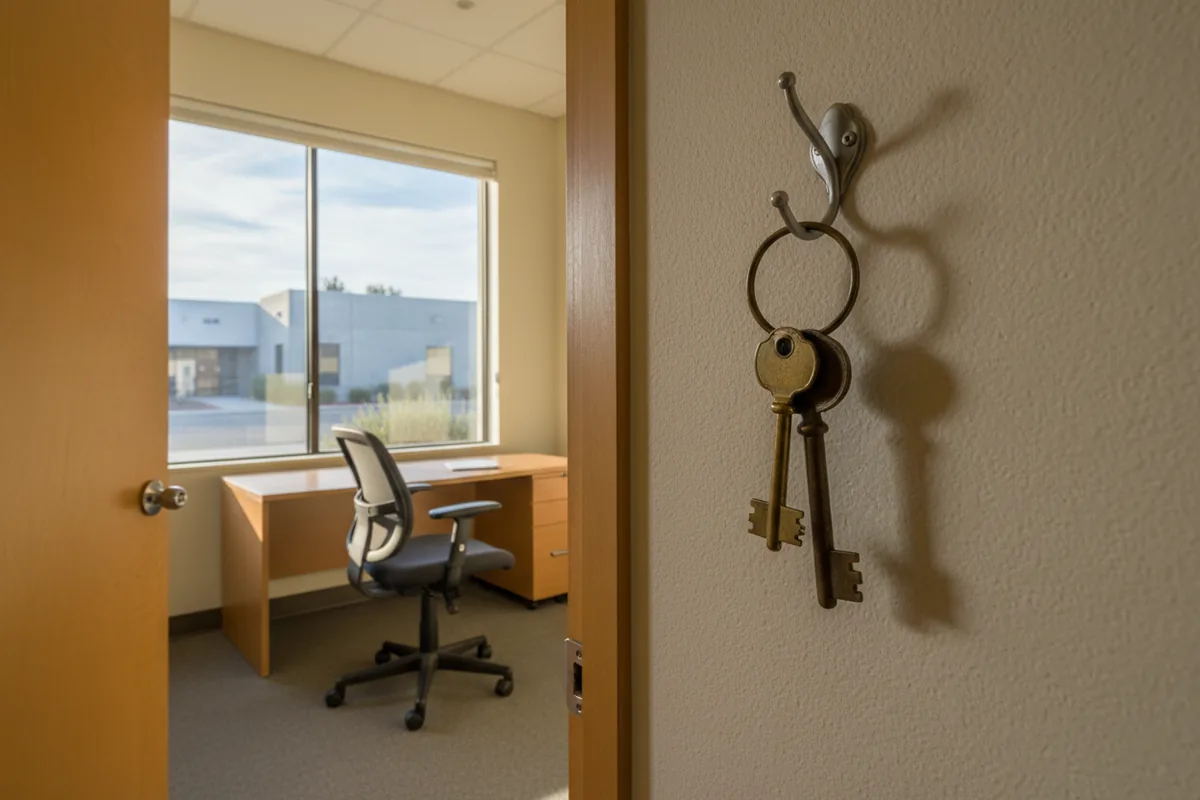
How a California sale-leaseback works: the sale is a change in ownership, the leaseback is a new lease, and a 35-year lease term changes the property tax result.
In a sale-leaseback, a California owner who runs a business from its own building sells the building and, at closing, signs a lease to stay on as the tenant. The owner receives the sale proceeds and keeps using the space. The sale is a change in ownership for property tax purposes, and the lease's length decides how property tax treats the lease.
Picture an owner whose company has operated from the same warehouse, office or shop for years. Much of the company's value is tied up in the building, and moving the operation would be disruptive. That owner wants to know what happens to title, to the property tax bill and to the business's right to stay once the building belongs to someone else. This guide walks through those questions as a buyer and the law will read them: the building, the new lease, the income that lease creates, and the tax rules that follow the sale.
What a Sale-Leaseback Means for an Owner Who Occupies the Building
A sale-leaseback is two transactions signed together. First, the owner transfers title to a buyer. Second, the buyer, now the landlord, gives the former owner a commercial lease, and the former owner becomes the tenant.
Each of those events has its own legal consequences. The transfer of title is a change in ownership under California property tax law, which the third section explains. The lease is a new contract that sets the rent, how long it runs, who pays which costs, and what happens when it ends.
Owners usually look at this arrangement when they need to stay in the building after the sale. Some want to keep operations running without a break. Others want to avoid the cost of moving equipment, staff and customers. Still others want to free up capital that is tied up in the real estate and put it into the business.
The lease term is the main variable throughout the deal. It shapes the business arrangement, because it sets how long the former owner can stay. It also shapes the property tax result, because California counts a lease's length when it decides whether the lease itself is a change in ownership.
Who a Sale-Leaseback Affects and When It Fits
The usual candidate is an owner-occupied commercial building: an office, a retail space, a warehouse, an industrial plant or a mixed-use building where the owner's own business operates. Relocating that business may be costly or impractical.
The contrast with a conventional sale is simple. In a conventional sale, the owner sells and moves out. In a sale-leaseback, the owner sells and stays as a tenant under a new lease.
That is the core trade. The owner gives up title and the equity that comes with ownership. In exchange, the owner keeps the right to occupy the space on terms that are set at the time of sale, including rent, duration and renewal options. After closing, those terms govern the relationship, and the former owner no longer controls the building.
How a sale-leaseback compares with a sale and a move, a refinance or simply holding the property depends on the owner's business needs, the lease terms a buyer will accept, and the tax consequences of the sale.
How the Buyer Looks at the Deal
A buyer in a sale-leaseback is acquiring an income-producing property with a tenant already in place. The buyer prices the deal by looking at the lease and the tenant behind it, so the length of the lease, the rent and the tenant business's financial strength all feed into what the buyer will pay.
In practical terms, the former owner is being evaluated twice: once as a seller of real estate and once as a future tenant. The buyer's interest in the tenant's financial strength follows directly from the fact that the rent is the return the buyer is paying for. An owner considering a sale-leaseback can expect the buyer's review to reach the business itself, not only the building.
The deal also involves the usual documents of a sale. The purchase agreement transfers title, and the deed, any loans or liens on the building, and any existing leases with other tenants all bear on what the buyer is acquiring and on what the seller must clear at closing. A real estate attorney reviews how those documents fit together with the new lease.
The Sale Is a Change in Ownership: What California Property Tax Law Says
California's property tax rules begin with a definition. Under Rev. & Tax. Code section 60, "A 'change in ownership' means a transfer of a present interest in real property, including the beneficial use thereof, the value of which is substantially equal to the value of the fee interest."
The sale of the building to the buyer transfers that full interest. As a result, the building's assessment is no longer anchored to the owner's long-held position: the county assessor reappraises the property after the sale.
The leaseback has its own rule. Rev. & Tax. Code section 61 generally treats "the creation of a leasehold interest in taxable real property for a term of 35 years or more (including renewal options)" as a change in ownership. A leasehold interest is the tenant's right to occupy under a lease. A long leaseback can therefore count as a second change in ownership in its own right.
The State Board of Equalization's Property Tax Rule 462.100, Change in Ownership—Leases sets out the other side. The creation of a leasehold interest for a term of less than 35 years does not constitute a change in ownership. The rule also says the calculation of a lease's term "shall include written renewal options." A leaseback under 35 years, options included, does not add a reassessment event of its own.
Section 61 also reaches the landlord's side. It treats "any transfer of a lessor's interest in taxable real property subject to a lease with a remaining term (including renewal options) of less than 35 years" as a change in ownership. The lessor is the landlord. Rule 462.100 adds that a transfer of a lessor's interest subject to a lease with a remaining term of 35 years or more is not a change in ownership, whether the transfer is to the lessee or to another party. A later sale of the building by the new landlord may or may not be reassessed, depending on how much of the lease term remains.
Two more points from Rule 462.100 matter here. Once a change in ownership of leased property has occurred, "the entire property subject to the lease is reappraised." Under section 61, only the portion of a property subject to the lease or transfer is treated as having changed ownership. How these rules apply to one building depends on the facts and the law that applies to them: the lease's written terms, how much of the property the lease covers, and how the assessor reads the documents. The county assessor's office is the office that answers that property-tax question.
The Leaseback Is a New Commercial Lease: What the Lease Terms Decide
At closing, the former owner becomes a commercial tenant under a new lease governed by California law. From that point, the lease, not ownership, defines the former owner's rights in the building.
The terms that tend to matter most are:
The base term. This is how long the lease runs before any renewal.
Renewal options. These count toward the 35-year line under Rev. & Tax. Code section 61.
Rent and escalation. This covers the starting rent and how it increases over time.
Operating expenses. A gross lease folds costs such as taxes, insurance and upkeep into the rent. A net lease passes some or all of those costs to the tenant.
Any purchase option. This is a right for the tenant to buy the building back on stated terms.
What happens when the lease ends. The lease sets out the end of the relationship, including the consequences if the tenant does not meet its obligations. Because the former owner no longer holds title, the right to stay depends entirely on those terms.
Renewal options are easy to underrate. In a hypothetical, a 20-year base term with one 15-year written renewal option reaches 35 years, so under section 61 the creation of that lease falls on the change-in-ownership side of the line. The option language in the draft lease is as much a property tax question as a business one.
The new landlord also owes a disclosure. Civil Code section 1938(a) provides: "A commercial property owner or lessor shall state on every lease form or rental agreement executed on or after January 1, 2017, whether or not the subject premises have undergone inspection by a Certified Access Specialist (CASp)." A CASp is a person who inspects premises against construction-related accessibility standards. The section defines "commercial property" as property offered for rent or lease to persons operating, or intending to operate, a place of public accommodation, or a facility to which the general public is invited.
If the premises were inspected, the section requires the landlord, in the circumstances it describes, to provide a copy of the CASp report before the lease is signed. If the report is not provided by the time the section sets before execution, the tenant has a right to rescind for a period after execution that the section also states. If the premises have been issued an inspection report showing they meet applicable standards, the landlord provides the current certificate and any report not already provided no later than seven days after the lease is executed. If no disability access inspection certificate has been issued, the lease must carry the statement the section sets out word for word. Repairs to correct violations noted in a CASp report are presumed to be the landlord's responsibility unless the parties agree otherwise.
In a sale-leaseback, the buyer is the new landlord and owes this disclosure on the lease the former owner signs. The repair-responsibility language is something the lease either keeps as the presumption or changes by agreement.
Tax Treatment of the Sale: Depreciation Recapture and Capital Gain
The sale side of a sale-leaseback is a sale of business property for federal income tax purposes. The IRS's Publication 544, Sales and Other Dispositions of Assets is the agency's guide to how those sales are figured and reported.
Depreciation is the yearly deduction an owner takes for wear on a building used in a business. When a depreciated building is sold, part of the gain may be treated differently because of those earlier deductions. Publication 544 explains how gain treated as ordinary income from depreciation is figured, and it defines Section 1250 property, the category that covers buildings. This is commonly called depreciation recapture. Years of depreciation deductions taken on the building can change the character of part of the gain at sale.
Publication 544 also says that gain or loss on business property "may be a capital gain or loss or an ordinary gain or loss," as discussed under its Section 1231 rules. Where property was used partly for business and partly for personal purposes, the publication says the selling price, the selling expenses and the basis are allocated between the parts. How the gain is treated depends on how long the building was held, how much depreciation was taken, and the owner's overall tax situation.
A 1031 exchange, which defers tax when business or investment real estate is exchanged for like-kind property, is a separate question. Whether a sale-leaseback can be part of one depends on how the transaction is structured. A CPA, an enrolled agent or a tax attorney reviews the income tax consequences of a sale-leaseback, including any exchange question, before the owner signs.
Options and Trade-offs: Sale-Leaseback Against Other Paths
An owner who occupies its building has several realistic paths, and each one trades something away.
Sale-leaseback. The owner gives up title, future appreciation and the equity that comes with ownership. The owner keeps occupancy, avoids relocation and receives the sale proceeds. In return, the owner takes on a tenant's obligations: rent, the term and any operating expenses the lease assigns.
Conventional sale and move. The owner gives up the building and the location. The owner keeps the proceeds free of any lease and bears the cost and disruption of relocating.
Refinance. The owner keeps title and occupancy and borrows against the building. The owner takes on new debt payments and leaves the equity in the property as the loan's security.
Hold. The owner keeps title, occupancy and any appreciation. The capital stays tied up in the real estate.
A direct sale to a buyer who pays cash and takes the building as it is has its own trade. A direct offer is often lower than an open-market sale price, because the buyer takes on the repairs, the risk and the cost of reselling. What the seller gains in exchange is less preparation, fewer showings and less dependence on a buyer's loan. In a sale-leaseback, the buyer's number also reflects its reading of the lease terms and the tenant's credit, not just the building, because the lease is the return the buyer is paying for.
Comparing written offers and estimated net proceeds is how an owner tells which path fits. Net proceeds are the price less commissions, transaction costs, taxes, carrying costs and loan payoffs. In a sale-leaseback, those proceeds sit beside the rent and other obligations the business will carry for the lease's full term, and the comparison is only as good as the numbers on both sides.
Common Mistakes in a Sale-Leaseback
Each of these errors traces back to a rule covered above. The second sentence of each item describes why it matters in practice.
Stacking renewal options past 35 years without checking the tax result. Under Rev. & Tax. Code section 61, the total term, options included, decides whether creating the lease is a change in ownership. In practice, an option added late in negotiations for flexibility can change the property tax outcome of the whole lease.
Treating the lease as an afterthought. The leaseback is a binding commercial contract, and its terms govern the former owner's occupancy for the full term. Once title has passed, the former owner has no ownership position to fall back on if those terms prove unworkable.
Overlooking depreciation recapture. An owner who has held and depreciated a building for years may see part of the gain treated as ordinary income, separate from any capital gain. That difference affects the after-tax amount the business actually has to reinvest.
Skipping tax review before signing. The terms that shape the tax result are set in the signed documents, so a CPA, enrolled agent or tax attorney looks at them while they can still change. After closing, the structure is fixed.
Confusing price with net proceeds. Transaction costs, loan payoffs and taxes all come out of the price before the owner receives anything. A higher price paired with higher rent can leave the business in a weaker position than a lower price with lighter lease obligations.
Missing the CASp terms. Civil Code section 1938 puts repairs noted in a CASp report on the landlord unless the parties agree otherwise, and a draft lease may shift that duty to the former owner. A former owner who knows the building's condition may accept that shift without weighing what the repairs could involve.
What to Do Next
A sale-leaseback evaluation usually starts with a short stack of records. Owners typically gather the current deed, any loan or lien documents on the building, the property's depreciation schedule, and any existing leases or occupancy agreements, including leases with other tenants in a mixed-use or multi-tenant building.
Several professionals shape the decision. A CPA or a tax attorney handles the income tax and depreciation recapture analysis. The county assessor's office handles the current assessed value and how reassessment would apply. A real estate attorney handles the lease terms and the purchase agreement.
The lease term, counted with every written renewal option, is the point where the business arrangement meets the property tax outcome under section 61. It is a question commonly raised with both the tax professional and the attorney before a term sheet is signed.
A practical starting point is the deed, the depreciation schedule and the county assessor's record of the building's current assessment. With those records in hand, an owner can sketch the lease term it would want, options included, and bring that question to the tax professional and the attorney.
How it works
A structured process, not a sales pitch
Describe your commercial property — asset type, size, occupancy, location and timeline — to clarify your selling path.
The seller intake
01
Describe the asset
Type, size, occupancy, location and timeline — six short steps.
02
Clarify the path
Listed, off-market, direct cash or sale-leaseback, based on fit.
03
Connect by consent
Information is shared only if you expressly agree.
Selling the warehouse without months of marketing was appealing to our ownership group.
— J.R., Miami, FL
We needed a buyer who understood leases, deferred maintenance and commercial closing timelines.
— Carmen K., Columbus, OH
My family kept asking about commercial tenant leases, and I honestly had no answer. We left with a much better understanding.
— S.T., Omaha, NE
I was skeptical at first. Then we got into the details of commercial tenant leases, and the whole situation started making more sense.
— Anika L., Seattle, WA
I never thought I would have to learn so much about commercial tenant leases. It was a lot easier with someone walking me through it.
— D.P., San Antonio, TX
It was the small things, like commercial tenant leases, that kept me up at night. Those questions actually got answered.
— Jude B., Santa Fe, NM
For me, it came down to commercial tenant leases. I appreciated the time spent getting that detail right.
— R.M., Baltimore, MD
The part nobody warned me about was commercial tenant leases. That ended up being a big piece of the decision.
— Soren H., Miami, FL
There were a hundred little details, especially commercial tenant leases. I appreciated that nobody brushed them aside.
— T.W., Columbus, OH
Frequently asked questions
What is a sale-leaseback transaction in real estate?
It is a sale in which the seller becomes the buyer's tenant at closing. The buyer acquires a building that already has a tenant, and the seller trades ownership for a lease. A transaction like this produces two sets of documents, a purchase agreement and a lease, and each carries its own obligations.
Does a sale-leaseback trigger property tax reassessment in California?
Yes, the sale transfers the full interest in the property and is a change in ownership. Whether the lease adds a second change in ownership turns on its length: 35 years or more, options included, does. Rule 462.100 also says that once a change in ownership of leased property occurs, the entire property subject to the lease is reappraised.
Do renewal options count toward the 35-year lease threshold?
Yes. Rev. & Tax. Code section 61 counts renewal options, and Rule 462.100 says the term calculation includes written renewal options. An option that is never exercised can still move a lease across the line, so the assessor reads the lease as written, not as the parties expect to use it.
Is a sale-leaseback an operating lease?
That is an accounting classification question, separate from the property tax and income tax rules covered here. How a business records the leaseback on its financial statements follows the accounting standards that apply to that business, and a CPA reviews the classification.
What happens to depreciation when I sell my building in a sale-leaseback?
Depreciation stops when the owner no longer owns the building, and the deductions already taken affect how the gain is figured. Publication 544 explains gain treated as ordinary income from depreciation on business property. A CPA, an enrolled agent or a tax attorney figures the specific consequence for one building.
What is the CASp disclosure requirement in a commercial lease?
Civil Code section 1938 requires the landlord to state on the lease whether the premises have undergone a CASp inspection, and adds report and certificate duties where one occurred. In a sale-leaseback, the duty runs from the buyer, as landlord, to the former owner, who may know the building's accessibility history better than the buyer does.
How does a sale-leaseback differ from a conventional sale?
Both transfer title, but only the sale-leaseback leaves the seller in the building. A conventional buyer usually prices the property mainly on its value as a building. A sale-leaseback buyer also prices the lease and the tenant's ability to pay rent over its term.
Can a sale-leaseback qualify for a 1031 exchange?
It depends on the structure of the transaction and the facts. A leaseback can affect how the exchange rules apply, and no single answer covers every deal. A CPA, an enrolled agent or a tax attorney reviews the question before closing.